The six face letters
“Clockwise” always means as seen while looking directly at that face. This is the part beginners most often get wrong: a clockwise D turn looks anticlockwise from above.
| Letter | Face | Meaning |
|---|---|---|
| F | Front | Turn the front face a quarter turn clockwise |
| B | Back | Turn the back face a quarter turn clockwise |
| R | Right | Turn the right face a quarter turn clockwise |
| L | Left | Turn the left face a quarter turn clockwise |
| U | Up | Turn the top face a quarter turn clockwise |
| D | Down | Turn the bottom face a quarter turn clockwise |
Prime and double turns
- R — right face, quarter turn clockwise
- R′ (“R prime”) — right face, quarter turn anticlockwise
- R2 — right face, half turn (direction does not matter)
Reading a short sequence
A sequence such as R U R′ U′ simply means: turn the right face clockwise, the top face clockwise, the right face anticlockwise, then the top face anticlockwise. Repeating a sequence like this several times returns the cube to where it started, which is a useful way to convince yourself the notation is doing what you think.
How notation relates to the app's moves
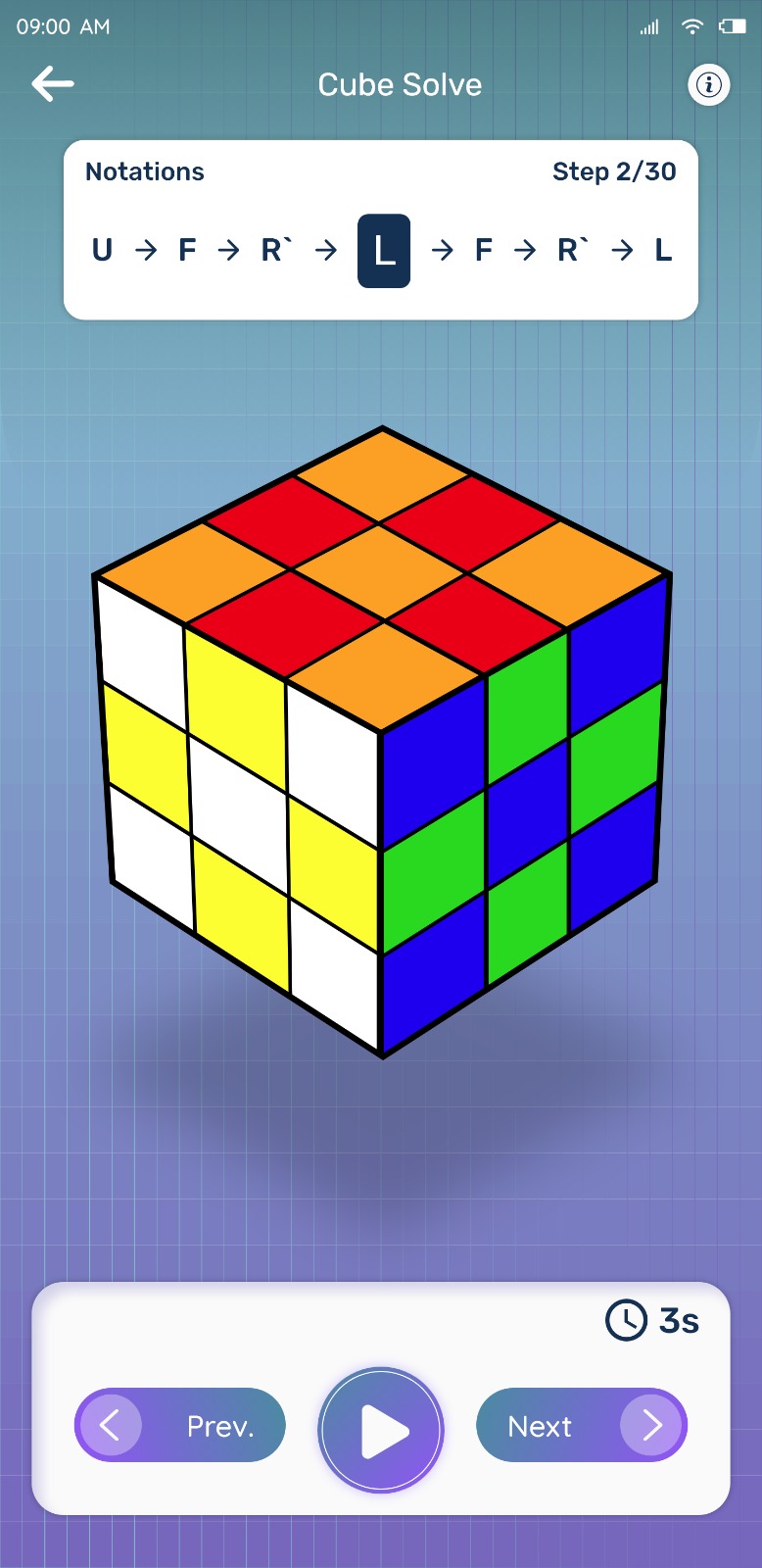
The Step-by-Step Solver in Rubik's Cube Solver produces a sequence of standard cube moves and shows them one at a time with the current step highlighted. Once you can read notation, that move list stops being a set of instructions to copy and becomes something you can understand — and eventually predict.
Practising notation on the virtual cube
A good way to learn notation is to make each turn on the Virtual Cube and watch what changes. Turning faces on screen and rotating the whole cube helps you connect a letter to a physical movement without needing a cube in your hands.
Notation tips
- Always judge clockwise from the perspective of the face you are turning
- Hold the cube still while performing a sequence — rotating it mid-sequence changes what the letters mean
- Learn R, U and F first; most beginner sequences use mainly these
- Say the moves out loud while you make them — it builds recognition quickly
Try Rubik's Cube Solver
Scan your cube and get step-by-step solving instructions in seconds. Available for Android on Google Play.